Below the £2bn Headline: The Compute Under Synthetic Training
The MoD’s £2bn Army Collective Training Service made headlines for its software and AI. Learn what the compute underneath synthetic training actually looks like, and why a 15-year contract is really three hardware generations.

Executive Summary
- The Ministry of Defence signed a 15-year, £2bn contract for the Army's Collective Training Service on 10 July 2026, won by the Omnia Training consortium with more than 44 British businesses in the supply chain.
- Coverage has focused on the software and AI. The hardware underneath is what decides whether the simulator keeps up with the trainee, and a 15-year term spans two or three hardware generations.
- Synthetic training is several different real-time jobs at once: GPU-bound visuals, CPU and memory-bound constructive simulation, latency-sensitive networking and time sync, and long-lived data capture.
- "Train anywhere" means a large share of the compute has to be deployable, which turns power, transit resilience, and offline operation into first-order engineering problems rather than afterthoughts.
What sits under the combat laboratory headline
On 10 July 2026, the Ministry of Defence signed a 15-year, £2bn contract for the Army's Collective Training Service. Omnia Training won it, a consortium led by Raytheon UK with Capita, Cervus, Rheinmetall UK, and Skyral, and more than 44 British businesses behind them in the supply chain. The Army calls the centrepiece the Combat Laboratory. It pulls simulation and live systems into one place and puts AI and analytics over the top. Around 60,000 soldiers a year are meant to train on it, in anything from a team of 100 to a formation of 50,000.
The coverage has mostly been about the software and the AI. This article looks at the hardware under it, because that is the part that decides whether the simulator keeps up with the trainee. Nothing here describes ACTS specifically, and there is no inside knowledge of how it is designed or built behind it. What follows is what the compute behind synthetic training generally looks like, from one simulator suite up to something this size, and what a 15-year contract does to the engineering.
Why fifteen years is really three hardware generations
The length of the contract is the first thing worth noticing. Fifteen years makes sense for a training service. The consortium gets time to invest and the Army gets continuity. In hardware terms, though, it is a very long time. A server or GPU bought this year has perhaps four to six years of front-line life in it. So the kit underneath will be replaced two or three times over the term, quite possibly while memory and storage prices are still climbing.
That changes how the system ought to be put together, on any programme like this. The simulation software has to move across hardware generations without being re-engineered each time. The licensing should not be tied to the particular box it runs on, or every refresh turns into a renegotiation. And it must cope with old and new hardware side by side, because nobody refreshes a multi-site estate in one weekend. Some sites will be on new kit while others are still running the last lot, and the training needs to behave the same on both.
Virtualisation does a lot of the heavy lifting here. Put a simulation workload in a virtual machine or a container on a standard hypervisor and you can move it from old hardware to new without the application noticing. The awkward part is the GPU, which is where PCIe passthrough earns its keep. The virtual machine gets the physical card at close to native speed and the hypervisor looks after the rest. When the GPU generation changes, you move the workload to a host with the new cards and update the driver. It is a planned change, not a rebuild.
What the synthetic training stack looks like from the floor up
Synthetic training is several quite different jobs that have to keep in step in real time, and each one wants different hardware.
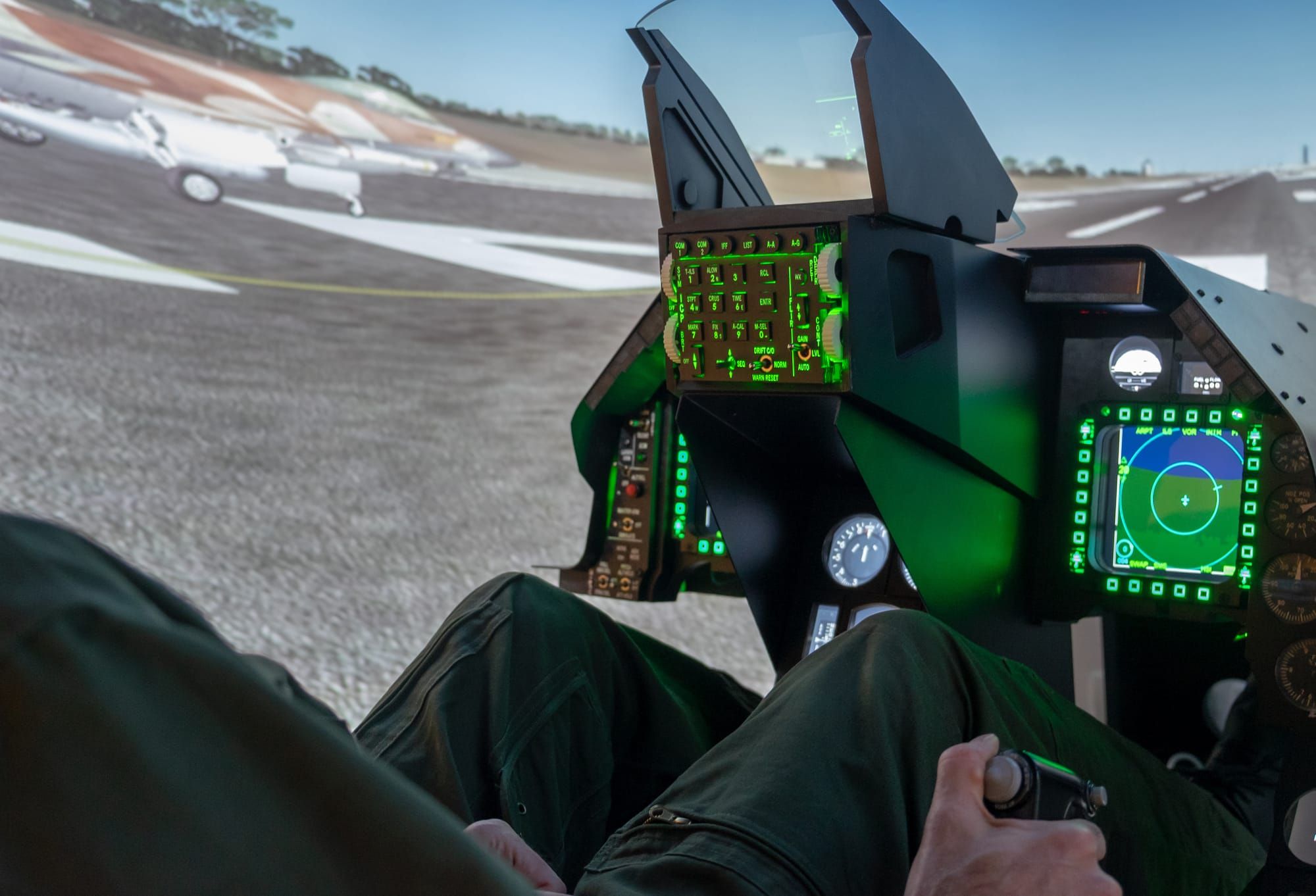
- The visuals: Image generators render the virtual world for operator stations, vehicle simulators, and instructor screens. That is GPU work, and it cares about frame rate and latency far more than most enterprise computing does. Nobody notices a dropped frame while a report renders. A trainee in a vehicle simulator certainly does, and enough of them spoil the exercise. Professional GPUs, proper cooling, and a well-built display chain count for more here than the benchmark charts suggest.
- The constructive simulation: Behind the visuals is the part that runs everyone nobody is directly controlling: the rest of the battlegroup, the opposing force, the civilian traffic. Training a team of 100 and training a formation of 50,000 are not the same problem made bigger. Entity counts climb, the interactions between them climb faster, and terrain queries pile up. This work leans on CPUs and memory, and likes plenty of cores, lots of RAM, and fast links between the nodes sharing the scenario.
- The glue: Distributed simulations swap state using interoperability standards such as DIS and HLA, and every system taking part needs to agree on the time. That makes the network and the time source part of the simulation itself. If the time sync is poor, events arrive in the wrong order, and the after-action review dutifully records something that never happened. The network wants low, predictable latency, simulation traffic kept apart from storage and management traffic, and one time source everyone trusts.
- The data: Mixing synthetic and live exercises means capturing position, sensor, and event data from both, plus video and audio from instructor and trainee stations, and keeping it long enough to be useful. The same storage rules apply as for sensor data: it must take a lot of data fast during the exercise, you need to prove afterwards that it has not changed, and holding it for years should not turn into a licensing problem as it grows. Training data stays useful for a long time. The exercise that looked routine this year is the baseline you measure against next year.
Why "Train Anywhere" is a power and transit problem
One line in the announcement is worth dwelling on: that the platform lets commanders and troops train anywhere, anytime. For training that is exactly the right ambition. For an engineer, it means a fair share of the compute has to be deployable and cannot just sit in a fixed building.
Deployable kit lives on whatever power it is given, and even the simple cases catch people out. Fifty laptops for a deployed training room sounds like the easy part of a job until someone asks where the power goes. A laptop that can drive a simulator is a mobile workstation with a serious GPU. A current example, with an Intel Core Ultra 7 and an RTX 5080, ships with a 280W or 330W charger. Call it 250W each under sustained load, which makes fifty of them 12.5kW, or about 54A at 230V. A typical UK ring main is protected at 32A and carries about 7.4kW, so the room needs the best part of two rings to itself. The same room full of office laptops on 65W chargers would draw about 14A, which is why the problem hides so well. Office planning also assumes most machines sit idle. Simulation runs the GPUs flat out for hours.
Then there are the sockets. A four-way extension lead is limited to 13A by the fuse in its plug, so fifty laptops means at least thirteen leads and the wall sockets to plug them into. Daisy-chaining leads to save sockets is how you end up past that 13A. Switch everything on at once and the inrush current can trip a breaker that would have coped with the running load. The answer is dedicated circuits or a proper 32A feed with rack power distribution, sized with headroom, and somebody has to work it out before the kit ships.
Moving the kit is harder on it than most people expect. On one project, deployable systems were built as racks in flight cases, three cases per system. The transit test failed three times in a row on vibration, with metal rack frames tearing like paper. The fix was a redesign: the racks went onto shock mounts and every cantilever was removed, meaning anything held at one end and left to swing. Every piece of equipment went onto all four posts of the rack, front and back, on custom rail mountings and hangers. Nothing in a datasheet prepares you for that. A rack that turns up at a training area with a fault means a cancelled exercise, not a support ticket, so the transit testing, burn-in, and acceptance testing all happen on the bench, with documentation to match. Deployable training kit is where that integration discipline bites hardest.
Finally, the link back to the main facility may be slow, patchy, or missing altogether. The local system has to run the exercise by itself and sync up afterwards. Software that needs a live connection for licensing, management, or updates will fail in the field, and it will do it at the start of the exercise, in front of everyone.
Why the british supply chain is the most encouraging detail
The 44-plus British businesses are the most encouraging detail in the whole announcement. Primes never deliver programmes this size on their own. They bring in specialists for software, content, instrumentation, hardware integration, and support. The prime owns the overall outcome and makes the pieces fit, and each partner has to deliver its piece quickly and to the programme's standards.
Hardware integration for simulation suits that model well. Doing it properly takes experience: the GPU choice, the thermal design, the display chain, deployable builds, and documentation an accreditor will sign off. But it is standard enough that nobody needs to reinvent it for each programme. The prime specifies the outcome and the integrator delivers tested, supportable systems against it, with spares and support that last as long as the hardware does. It goes wrong when compute is treated as a commodity line on a spreadsheet, and the first exercise shows that the cheapest GPUs on the list cannot hold frame rate at the resolution required.
A measured word on the AI
There is a lot of AI in the announcement, and the after-action use is a good one. Software can go through thousands of hours of exercise data, mark the point where a unit's tempo dropped, and put decisions next to what came of them. Instructors would do that themselves if they had the hours. Let the software do the first pass and they get those hours back. The instructor still has to decide what the pattern means and what to do about it. The software just gets them there faster.
The compute for that is modest compared with the visuals and the simulation. You need some GPU capacity for it, nowhere near a data hall, and it can run overnight after the exercise. Size it for the analysis you plan to do. If it gets sized to the AI headlines instead, the money comes out of the image generators, and those are what the trainee sits in front of.
You may not need to buy much for it at all. Once the exercise is over, the image generator GPUs are sitting idle, and they are good GPUs. If the image generators run as virtual machines with passthrough, you can shut them down at the end of the day, start the analysis machines on the same cards, run overnight, and swap back before the next exercise. There are catches: it only works if the suite has quiet periods, cards chosen for frame rate may be short of memory for bigger models, the exercise data has to reach those nodes quickly, and any GPU licensing needs checking for the second use. But the compute for the debrief may already be in the room.
Key Takeaways
- A 15-year training contract spans two or three hardware generations, so the system must let simulation software move across generations without re-engineering, with licensing untied from the box and old and new kit running side by side.
- Synthetic training is four jobs at once: GPU-bound visuals, CPU and memory-bound constructive simulation, latency and time-sync-critical networking, and long-lived tamper-evident data capture.
- "Train anywhere" makes power, transit resilience, and offline operation first-order problems. Fifty simulator-grade laptops can draw around 54A, needing the best part of two UK ring mains, and deployable racks need shock mounting proven on the bench.
- The 44-plus British businesses in the supply chain fit the prime-and-integrator model well, provided compute is treated as engineered capability rather than a commodity spreadsheet line.
- The after-action AI is a genuine benefit but modest in compute terms, and idle image-generator GPUs may already cover it. Size it to the analysis, not the headlines, or the money comes out of the visuals the trainee actually uses.
What a soldier experiences in the simulator comes from well down the stack. Does the frame rate hold when the scenario gets busy? Do the linked simulators agree on the time? Does the rack at a remote training area start first time on a wet morning? Does the exercise data reach the debrief intact? None of that will make a press release, and all of it decides whether the training works. Over fifteen years the hardware will be swapped two or three times, and whoever runs it will either have planned for that from the start, with portable workloads, licences that do not care which box they are on, and documentation good enough to rebuild from, or they will be finding out the hard way in year six.
To discuss Proxmox deployment, open-source infrastructure design, or migration from VMware for your defence programme, contact Ross Collins or reach out here.